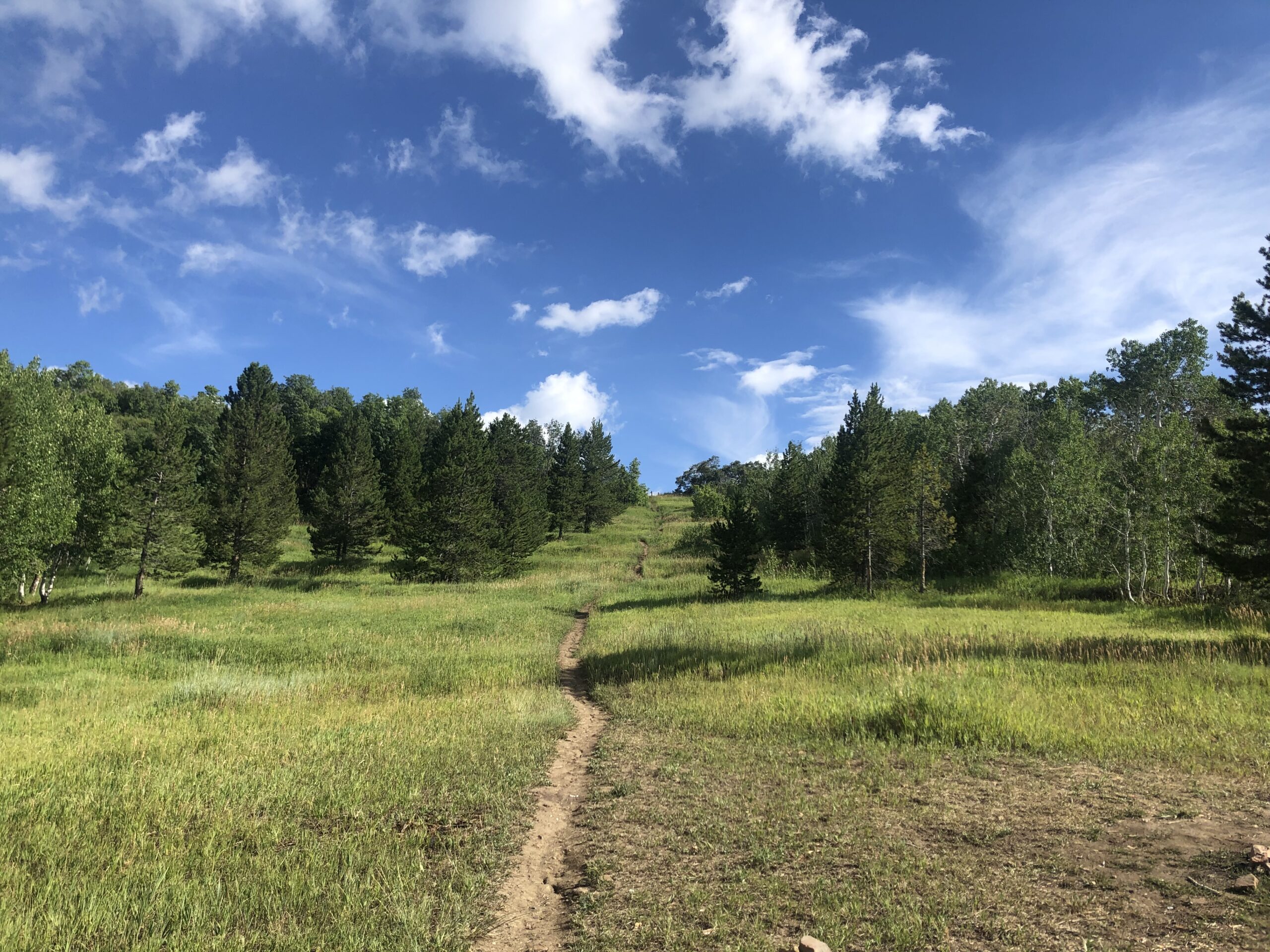
Have you ever painted?
You stand in front of a blank canvas, and quite often you have no idea what you’re going to create with it. You have some paints, they’re in a cardboard shoe box you keep in the cupboard with some tattered brushes and sponges, a paper plate is your pallet and it’s been working hard for longer than its intended shelf life. Dip dip, splash, you start painting something.
Now have you ever written? You sit in front of a blank page, a blinking cursor or lines in a notebook. Your brain is the pallet, your fingers the brushes. Dip dip, splash, you start an opening line.
“It was a dark and stormy night…”
Nope, start again.
Both writing and painting are done in strokes. You add color in layers, mixing them just right, sometimes wet so it blends, sometimes dry so the color pops like the center of a star. When someone looks at your art, their brain fills in the colors, the microscopic spaces between, and creates a representation of the reality depicted. In a way, the emotion a person experiences from your creativity belongs entirely to them, a construct inside their mind from brushstrokes of imaginative color.
How is painting like writing?
They say that a picture is worth a thousand words, but it’s also true that a few words paint a picture. Let’s look at the opening line of Metamorphosis by Franz Kafka.
“As Gregor Samsa awoke one morning from uneasy dreams he found himself transformed in his bed into a gigantic insect.”
Franz Kafka, Metamorphosis
Do you see the painting? It isn’t perfectly realistic in your head. You see a man in a bed transformed into a giant insect. The author hasn’t told you what kind, but your mind is already starting to figure that out. I bet it looks different than my insect in my head. Like brushstrokes on a canvas, Kafka created a representation of reality, and your mind is initiating the response, emotion and color all painted into a fuzzy picture you can keep working on as the story continues.
Bob Ross and Quick Strokes
Check out this video, you can skim around, just pay attention to the swiftness of his strokes. When he paints the trees, it doesn’t look like he’s creating photorealistic trees. He just creates something your mind can quickly interpret. You don’t see the print of the brush, you see a beautiful landscape. The same should go for your writing. Sometimes, the quicker the stroke, the more concisely packed the information, the better the broader image.
For reference, let’s look at another example by our pal George Orwell in his novel 1984
“It was a bright cold day in April, and the clocks were striking thirteen.”
Are you getting the picture? You can feel the cool air where the sun doesn’t quite warm your skin, and a clock tower shows thirteen, and it makes you uncomfortable. But you can see other things can’t you? I can see an old fashioned street with warm April colors shining on dew over drab government buildings. He didn’t write any of that, but from the painted emotion of the first sentence, my mind goes to that street on its own.
Why should we think about writing like painting?
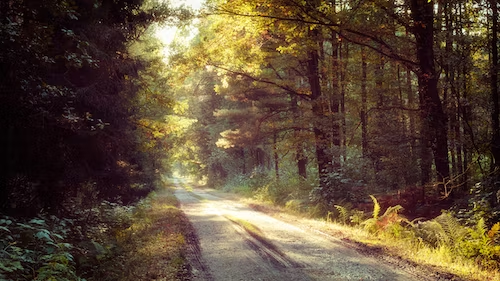
By Lucasz Szmigiel on Unsplash
Here’s one example of how thinking about writing as painting could help. When you paint a road, you have to know where the lines are going. Even though the intersecting sides of the road will never touch in the painting, the correct angle means you as the artist need to know at what point they will touch on the horizon. When you’re writing a story, there’s so much exposition you have to know as an author to make something believable. A character may only enter the story for a moment, but do you know the angle of their road? A line of dialogue may go unsaid, but do you know what the characters are thinking? Remember that the reader’s mind is continuing the images you started with your words. Even if some exposition only makes it to the white space resting between printed ink, the emotional direction of your story will benefit from your work on the angles. Your reader will arrive at the conclusions they should.
In a nutshell
I think about the concept that my writing is a moving portrait in the mind of my readers. Each brushstroke has to add, but not detract from my story. If something is suspenseful, my word-strokes are quick. If time slows down, my descriptions flow with the speed of perception in eternal moments. I also remember that if I cut something out of the writing, the lines of the road will better intersect, just like a painting.
How do you see your writing? Does it feel like painting, or something else? Let me know, this is a discussion I’ve been wanting to have.