Category: Journey

  • Ways Border Collies Can Actually Make the Best Family Dogs

    Ways Border Collies Can Actually Make the Best Family Dogs

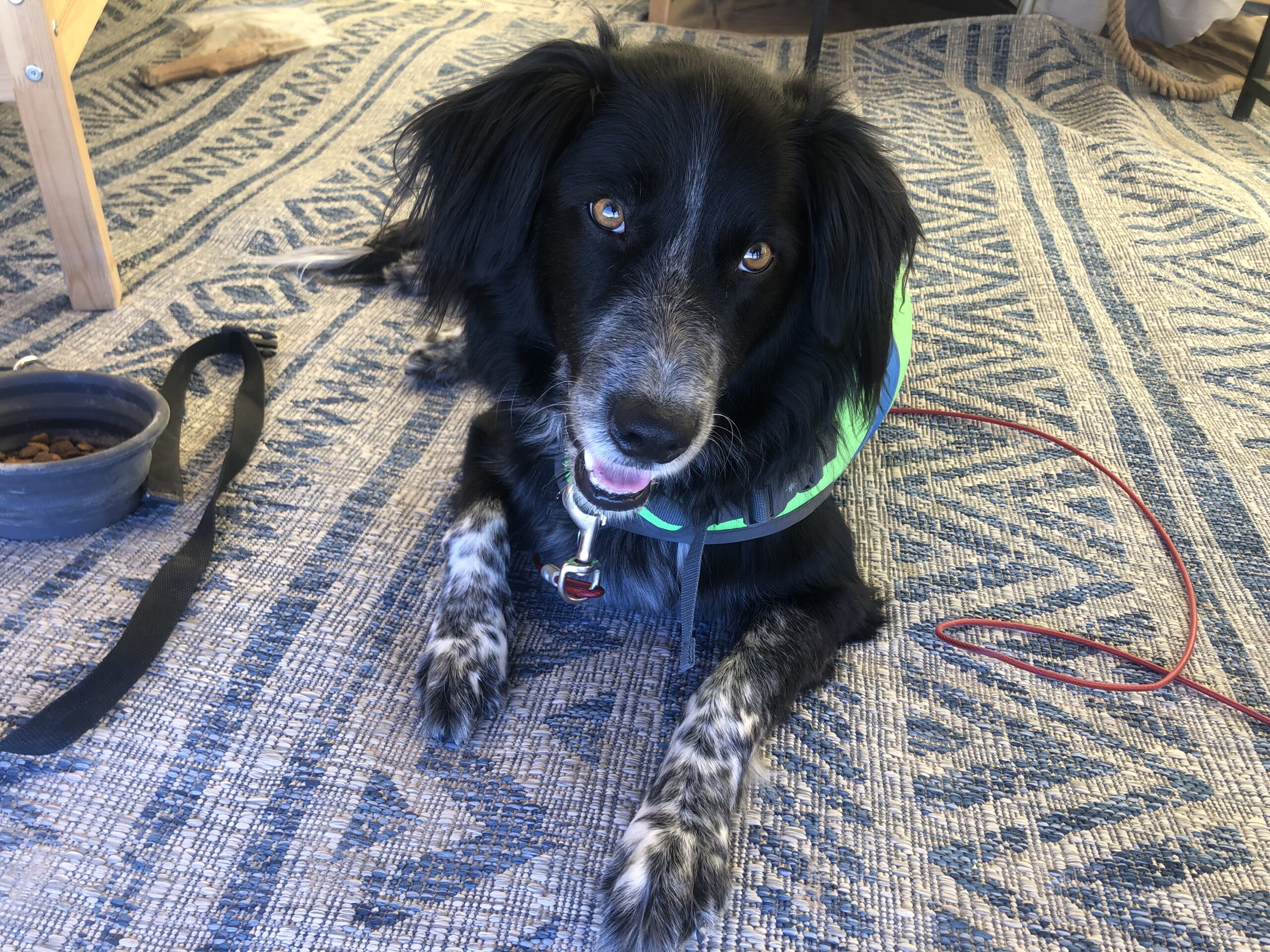
    This is Arthur.

    He’s an adopted Border Collie from the county animal shelter. I rescued him in 2019 on National Dog Day when he was 10 months old. I didn’t know it was National Dog Day, but the coincidence was convenient because the shelter waived a whole bunch of fees and I could actually afford him. Let me tell you, don’t be fooled by what you read online, Border Collies like Arthur make the best family dogs.

    Not all dogs are the same, even within a breed, so you should evaluate each dog you meet individually. I’ll just tell you about Arthur.

    Great with kids

    I don’t know if you knew it, but raised properly Border Collies can be fantastic, protective, and loyal to children. They’ve even been known to want to heard them together like sheep in their care. When he was first adopted, Arthur would get nervous when kids would touch him, but after playing fetch with my nephews, he learned that kids were even more fun than adults because they’d play fetch for as long as he wanted to, or even longer, which is insane if you know the endurance of Border Collies.

    Built for Adventure

    Border Collies are made for the outdoor lifestyle. They love open fields and long hiking trails. Being very obedient dogs, you can take them with you off-leash (where it’s allowed, of course.) They’ll love to go with you almost any place you can imagine. Go ahead and read my article about off-leash hiking for more information. In addition, as herding dogs, they’ll likely see children as sheep they need to keep together, so they’ll help make sure the family stays accounted for on long expeditions.

    Well Behaved in the House

    As natural working dogs, many people have the misconception that Border Collies are bad house/apartment dogs. My dog Arthur had a hard time settling down at first indoors, but he’s since learned to be very comfortable. We’ve lived in both houses and apartments together, and he knows how to behave. I would recommend crate training, at least for young Border Collies at first because they tend to get extra bored when you’re not around. They’re little smart escape artists and food finders.

    Border Collies are extremely attached to their families, so they want to be wherever you are. If you are in the house, they want to be in the house. If they want to be outside, they’ll want you outside with them.

    They Love to Cuddle

    The heading speaks for itself, doesn’t it?

    Photo by Undine Tackmann on Unsplash

    Get Down to the Shelter and Adopt

    Of course raising a dog from puppy on up is a wonderful experience, but remember to consider adopting from your local shelter. Border Collies are often left in rescues by their owners who don’t understand what kind of amazing companions they can become. Adopting Arthur was the best decision I ever made. So, if you’re on the fence, head down to the shelter and take a Border Collie mix into the playroom. I bet you’ll like what you find.

  • How Writing is Like Painting

    How Writing is Like Painting

    Have you ever painted?

    You stand in front of a blank canvas, and quite often you have no idea what you’re going to create with it. You have some paints, they’re in a cardboard shoe box you keep in the cupboard with some tattered brushes and sponges, a paper plate is your pallet and it’s been working hard for longer than its intended shelf life. Dip dip, splash, you start painting something.

    Now have you ever written? You sit in front of a blank page, a blinking cursor or lines in a notebook. Your brain is the pallet, your fingers the brushes. Dip dip, splash, you start an opening line.

    “It was a dark and stormy night…”

    Nope, start again.

    Both writing and painting are done in strokes. You add color in layers, mixing them just right, sometimes wet so it blends, sometimes dry so the color pops like the center of a star. When someone looks at your art, their brain fills in the colors, the microscopic spaces between, and creates a representation of the reality depicted. In a way, the emotion a person experiences from your creativity belongs entirely to them, a construct inside their mind from brushstrokes of imaginative color.

    How is painting like writing?

    They say that a picture is worth a thousand words, but it’s also true that a few words paint a picture. Let’s look at the opening line of Metamorphosis by Franz Kafka.

    “As Gregor Samsa awoke one morning from uneasy dreams he found himself transformed in his bed into a gigantic insect.”

    Franz Kafka, Metamorphosis

    Do you see the painting? It isn’t perfectly realistic in your head. You see a man in a bed transformed into a giant insect. The author hasn’t told you what kind, but your mind is already starting to figure that out. I bet it looks different than my insect in my head. Like brushstrokes on a canvas, Kafka created a representation of reality, and your mind is initiating the response, emotion and color all painted into a fuzzy picture you can keep working on as the story continues.

    Bob Ross and Quick Strokes

    Bob Ross “Island in the Wilderness”

    Check out this video, you can skim around, just pay attention to the swiftness of his strokes. When he paints the trees, it doesn’t look like he’s creating photorealistic trees. He just creates something your mind can quickly interpret. You don’t see the print of the brush, you see a beautiful landscape. The same should go for your writing. Sometimes, the quicker the stroke, the more concisely packed the information, the better the broader image.

    For reference, let’s look at another example by our pal George Orwell in his novel 1984

    “It was a bright cold day in April, and the clocks were striking thirteen.”

    Are you getting the picture? You can feel the cool air where the sun doesn’t quite warm your skin, and a clock tower shows thirteen, and it makes you uncomfortable. But you can see other things can’t you? I can see an old fashioned street with warm April colors shining on dew over drab government buildings. He didn’t write any of that, but from the painted emotion of the first sentence, my mind goes to that street on its own.

    Why should we think about writing like painting?

    By Lucasz Szmigiel on Unsplash

    Here’s one example of how thinking about writing as painting could help. When you paint a road, you have to know where the lines are going. Even though the intersecting sides of the road will never touch in the painting, the correct angle means you as the artist need to know at what point they will touch on the horizon. When you’re writing a story, there’s so much exposition you have to know as an author to make something believable. A character may only enter the story for a moment, but do you know the angle of their road? A line of dialogue may go unsaid, but do you know what the characters are thinking? Remember that the reader’s mind is continuing the images you started with your words. Even if some exposition only makes it to the white space resting between printed ink, the emotional direction of your story will benefit from your work on the angles. Your reader will arrive at the conclusions they should.

    In a nutshell

    I think about the concept that my writing is a moving portrait in the mind of my readers. Each brushstroke has to add, but not detract from my story. If something is suspenseful, my word-strokes are quick. If time slows down, my descriptions flow with the speed of perception in eternal moments. I also remember that if I cut something out of the writing, the lines of the road will better intersect, just like a painting.

    How do you see your writing? Does it feel like painting, or something else? Let me know, this is a discussion I’ve been wanting to have.

  • Hiking to Scout Cave in Snow Canyon near Saint George, Utah

    Hiking to Scout Cave in Snow Canyon near Saint George, Utah

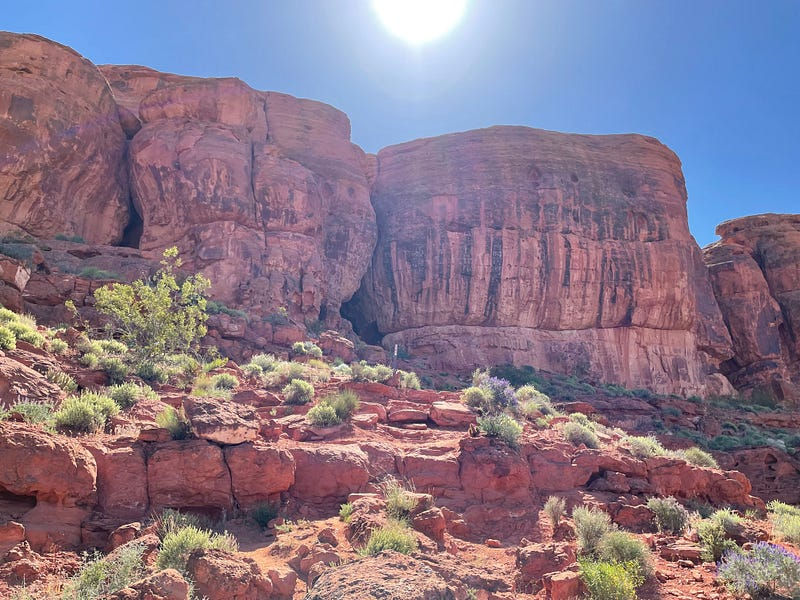
    Hiking up to Scout Cave is a simple and short activity to add to your must-visit category in Saint George, Utah. In this article, I’ll sum up where you can find it and some tips and tricks to help you have a good time and stay safe. Scout Cave is dog friendly, unlike many hikes in the area, so we’ll talk about furry friends too.

    Difficulty

    Before you drive up to Snow Canyon, let’s talk about difficulty. If you are an experienced hiker and climber, Scout Cave will not give you any trouble. However, if you have any health problems or issues climbing a little, you should consult a doctor first. The same goes for your dog. Dogs that can’t climb will need to be carried up a few brief slopes. My border collie had no problem climbing on his own with a little guidance.

    Children outside of strollers can hike this trail without a problem, but should be closely monitored and assisted by adults. There are a lot of poky plants around and some insects. In the springtime, I got stung by a bee in the cave.

    Photo by Daniel Bradley

    Heat and Time of Day

    Scout Cave is best attempted in the morning or evening outside of the full blast of the afternoon sun. Dogs with thick fur coats should be watched closely and given plenty of water, as well as their humans. The heat can sneak up on you. It may feel moderate at 9 am and then by 10 or 11 you’re sweating buckets. Try to make it just after sunrise if you can. If you do leave later, it’s best if you leave your dog at home and bring lots and lots of water.

    This hike is almost completely without shade except for some trees near the bottom before you reach the stairs.

    Photo by Daniel Bradley

    Length

    Scout Cave is just under 3.6 miles round trip. Apart from a steep climb up some stairs and a few rocks to climb over, the trail is relatively flat and easy going. The terrain is rocks and sand and should be a little cooler for your pups paws than asphalt.

    Photo by Daniel Bradley

    Driving Directions

    Take exit 6 on I-15 onto Bluff Street and turn north toward Pine Valley Mountain. Continue for about 3 and a half miles. Turn left onto Snow Canyon Parkway and keep going for about 4 miles. On Snow Canyon Dr, turn right and continue 1 mile. You will see a Trailhead on your right across the street from where you can park.

    The Trail in a Nutshell

    The trail is straightforward enough. Cross the street from the parking lot and you’ll see the trailhead. Head toward the mountains in front of you. You’ll pass old lava flows and beautiful desert plant life. Eventually you’ll hit an intersection with the Johnson Canyon Trail. Turn right, following the Scout Cave trail and keep going to where the trail passes under some private housing. Follow the trail down to the area at the bottom with trees and sand.

    Photo by Daniel Bradley

    Make sure you’re drinking lots of water.

    The trail will head back uphill at some stairs. Take your time and be sure to not fall into any cacti. The trail will seem to end, but if you noticed, you’re on your way to the cave. Climb up the rocks and you’ll see that the trail continues upward. After the stairs, be sure to not turn right. There is an illegal trail heading into the canyon and that is not where you want to go.

    Photo by Daniel Bradley

    Climb on up into the cave and enjoy the view!

    Also as I mentioned before, try not to get stung by any bees. My arm was swollen for two days.

    Photo by Daniel Bradley
    Photo by Daniel Bradley

    The cave overlooks the valley below.

    Thanks for reading! If you enjoyed this article, find this one and more at:

    dbradleyexplores.com

    and my Youtube channel:

    https://www.youtube.com/@dbradleyexplores

  • Tough Love: A Basic Training Story

    Tough Love: A Basic Training Story

    I can’t quite remember his name, it was like Higgins or something. That’s what I’ll call him anyway. We were a bunch of bald-headed privates in our first week of basic training. That sentence sounds funny out of context. The drill sergeants herded us under the tower we just repelled from for our next task, a high up obstacle course of ropes and nets that made my stomach flip upside down, in a good way.

    Higgins looked like he was gonna curl up and die. He stood barely over five feet tall, if that, and was skinny enough that the ugly glasses on his nose were his only distinguishing feature. The recruiter who brought him in must’ve really wanted that office backpack for good numbers or something, because this kid was never meant for the army. Weak body, zero resolve, you’ve gotta admire signing your life away but service should never be open to some people, especially an MOS like combat engineer. Brawn, assertiveness, confidence, all void in little Private Higgins. Maybe there’s a little circle of laughing recruiters in Hell somewhere. I can see it.

    The drill sergeants showed us how to do the course by doing it themselves, leading in patronizing example. I remember feeling a little overwhelmed, Basic was emotionally exhausting. I held my motivation close, though. Just home from living in South America and the craziness of that experience, I felt like I could conquer anything. I wanted to conquer everything.

    Higgins looked like a turtle without a shell that day. The drill sergeants took advantage, identifying him as the weakest member of the hundred-something group. 

    “Higgins! You’re first! Get up that rope!” [Edited and paraphrased for language]

    The rope came down from a near vertical wooden wall that led to the rest of the obstacles. He grabbed hold and tried to climb. His arms trembled after a couple of feet and he stumbled down. He tried to mumble about not being able to do it, but the sound had a hard time getting out of the shaking frame wearing camo.

    Fast forward a few attempts, the biggest drill sergeant shook the ground as he stomped and screamed at the shaking private. “Higgins! I’m coming up behind you, and you do not want me to catch you!”

    We’d felt the drill sergeant’s hands before. The man was an ox of a human. He looked like he was birthed straight out of an 80’s action movie or a Gears of War video game. I still have a couple scars on my hip from where he tightened my repelling harness. “RUN HIGGINS! CLIMB!” We screamed in fear for his life.

    Higgins took to the rope like an Olympian, climbing with a strength he never knew he had. He did every obstacle with little hesitation, but quaking from shaved head to foot with the storm of a screaming real life action star thundering through the obstacles behind him. “I’m gonna get you Higgins! Don’t you dare stop!”

    The little private reached the bottom of the course in the glory of our cheering enthusiasm. We all couldn’t wait to get through the course ourselves. Suddenly it looked fun. It was also near time for chow and we wanted to finish and eat. Those ten minute meals were valuable. But that was some of the most pride of ever seen in someone’s eyes. The victory of little Higgins.

    There’s a moral to this story, and the reason I’ve been thinking about it. The scope of a person’s capability is only as strong as whatever is lighting his/her hind-parts on fire. Sometimes, a little tough love is the best thing you can do for someone.

    Fin

  • Visiting the Roman Baths in England

    In the West of England and 100 miles from London you find a treasure that’s thousands of years in the making: Old Roman Baths in a city called Bath that have brought multitudes both ancient and modern to witness priceless natural and archaeological wonders. People have emigrated to Bath since even before Roman times for England’s only hot springs as a place of healing and worship. When visiting Bath in 2022, I experienced an enlightening connection with history that I hope to share. Wherever we live as human beings, we tread our footsteps over the lives and legacies of billions. The Roman Baths help illustrate this with wonderfully preserved ruins that anyone can see…for a few pounds.

    Photo by Paul Cuoco on Unsplash

    Getting to Bath

    If you’re traveling from London, I would recommend renting a car. Renting a car can be pricy, especially if you’re limiting yourself to only automatic transmissions, but renting can be worth it if you plan on using Bath as a hub to travel to other locations. The car can also save you a lot of time. However, parking can be hard to find during peak visiting times. Bath is a major shopping destination and my group and I drove in right during the peak of Guy Fawkes Day. We found one public parking space after driving around several times. If it weren’t for Google Maps, which I would recommend as your main source of navigation, I think we might have circled that town for eternity.

    Knowing this, if you’re uncomfortable driving or you prefer public transportation, bus and train options are available. You can find them at:

    https://www.romanbaths.co.uk/visit

    This website is useful because they’ve simplified your choices to the most prudent. National Express has a bus service from the Heathrow and Gatwick airports and after a couple hours or so you’ll find yourself a five-minute walk from the Roman Baths.

    The train station is called Bath Spa, and the slowest but cheapest option is London Waterloo. More expensive but faster services are available.

    Photo by Suzi Kim on Unsplash

    What to Learn at the Baths

    Sulis Minerva: Photo by N C on Unsplash

    The Audio Tour of the Roman Baths in Bath offers an informative look into the lives of Roman people in about 60 AD. The Romans named the town Aquae Sulis, or the waters of Sulis, after the Celtic goddess worshipped at the hot springs before the romans arrived. The Romans associated Sulis with Minerva.

    Photo by Daniel Bradley

    The baths in Roman days were a complex system of pools of varying temperature for bathing. There’s evidence that people would come as a sort of pilgrimage from across the empire to experience the warm healing effects of the mineral water.

    Photo by Daniel Bradley

    They would even heat stones to make a hot floor for bathers.

    Photo by Daniel Bradley from the Roman Baths Museum in Bath

    These examples only touch a small part of the vast knowledge found under the ground at the Roman Baths. The real wholistic lesson I took away came from the overarching theme of syncretism.

    Natural Subterranean Syncretism

    At the end of the museum tour, we had the opportunity to drink the water after its purification. The walls around the fountain were full of quotes throughout history of the believed healing benefits:

    Photo by Daniel Bradley
    Photo by Daniel Bradley

    When I drank a cup of the water, I couldn’t help but feel the impact of an amalgamation ancient beliefs, whether I held them the same or not. I thought of the underground veins where the water passed through Celt, Roman, and British worlds under my feet. Studying the history and drinking the water felt like a temporal connection to the long dead, like I could honor them with a few bitter gulps of mineral water.

    Natural syncretism isn’t a forced interfaith dialogue or lesson, it’s simply existing alongside ghosts of the past. Visiting the Roman Baths brought me closer to my ancestors, British and Roman, in a way that I didn’t know possible. If you find yourself in or around London, consider taking a side-step westward toward Bath and see these sites for yourself. If you’re a history buff and creative minded like me, you’ll have the time of your life. I was so influenced by my experience that I’m using what I learned for an upcoming novel.

    For More Information

    I would advise visiting the site I posted above for travel information. Pricing I’m sure is subject to change as well as other visitation guidance. The most important thing is to educate yourself from real sources before going.

    For references, all my photos were taken by myself at the museum or borrowed from Unsplash and credit is given to the photographers for their expert work.

    We live in a rich world of a million billion legacies. I’m glad we have a place like the Roman Baths where we can learn to appreciate them.

    Photo by K. Mitch Hodge on Unsplash